
Advances in reproductive science are allowing researchers to observe and manipulate the earliest stages of human life in ways that were once unimaginable. This three-part New York Times series explores how scientists have learned to grow and study human embryos in the lab, the ethical boundaries that have shaped this research—most notably the long-standing 14-day rule—and the new technologies that are pushing those limits. As tools like embryo models, genetic screening, and gene editing evolve, the series asks what society should allow scientists to do with human embryos—and who gets to decide.
Articles in the Series
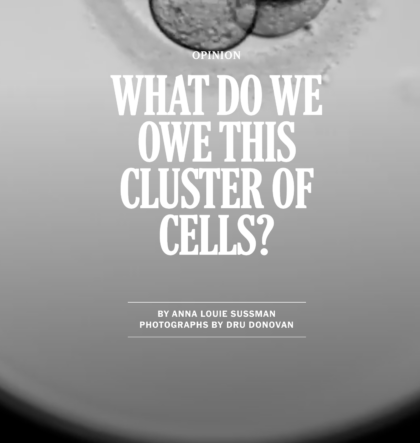
- Part 1: “What Do We Owe This Cluster of Cells?” (March 25, 2025)
- Part 2: “Should Human Life Be Optimized?” (April 1, 2025)
- Part 3: “Are Embryos Property? Human Life? Neither?” (April 8, 2025)